Balkan Village by Irwin T. Sanders
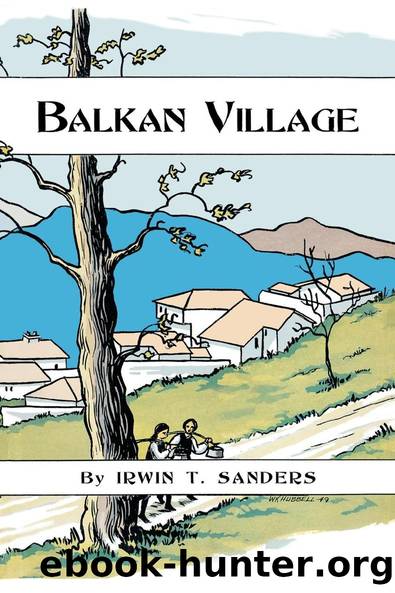
Author:Irwin T. Sanders [Sanders, Irwin T.]
Language: eng
Format: epub
Tags: History, Russia & the Former Soviet Union, Political Science, Political Ideologies, Communism; Post-Communism & Socialism, Social Science, Sociology, Rural, Social History, Regional Studies
ISBN: 9780813194943
Google: BeMzEAAAQBAJ
Goodreads: 22618729
Publisher: University Press of Kentucky
Published: 2014-07-15T00:00:00+00:00
CHAPTER VIII
FAMILISM, A CHANGING WAY OF LIFE
THE DAY at last arrived when I could anticipate the peasantsâ answers to most of the questions that I asked them. When I inquired what they would do if they had five hundred dollars to spend, I could list in advance the items they would name. The older people, especially, thought and acted largely in terms of the Dragalevtsy of the âgood old days,â when life was lived in a familistic way because the family played the major role in the community. When I understood the characteristics of familism, as a result of observing and reading about peasant life in other parts of the world, the many interesting but isolated facts I had noticed in Dragalevtsy began to make sense and to form a pattern. In a familistic society, whether it is in the Balkans or China, life is largely customary and traditional. Individualism is discouraged because of the crises that the unusual person creates in the daily routine. People prefer a dead uniformity, or a leveling of the best toward the mediocre. The family plays the leading part in this task of molding an individual into the accepted pattern. From childhood to old age the kinship group brings pressure to bear upon any nonconformist, since the family as a whole loses prestige in the community if a member gets out of hand. The family, too, is the chief training ground for the young, and parents cannot blithely transfer any responsibility of this sort to an outside agency such as the school or the church. Village opinion holds the parents accountable.
Furthermore, economic life is centered about the family. Since family members grow or make for themselves most of the things they need, they depend only to a minor degree upon stores, factories, and other commercial agencies. The family is the productive, distributive, and consumptive unit. This is one reason why village families can weather so many wars and so many depressions: they can satisfy most of their immediate wants at home.
Download
This site does not store any files on its server. We only index and link to content provided by other sites. Please contact the content providers to delete copyright contents if any and email us, we'll remove relevant links or contents immediately.
Spell It Out by David Crystal(36243)
Life for Me Ain't Been No Crystal Stair by Susan Sheehan(35903)
The Great Music City by Andrea Baker(33663)
Cecilia; Or, Memoirs of an Heiress — Volume 1 by Fanny Burney(32724)
Cecilia; Or, Memoirs of an Heiress — Volume 2 by Fanny Burney(32090)
Cecilia; Or, Memoirs of an Heiress — Volume 3 by Fanny Burney(32068)
Professional Troublemaker by Luvvie Ajayi Jones(29763)
The Secret History by Donna Tartt(19473)
We're Going to Need More Wine by Gabrielle Union(19174)
Twilight of the Idols With the Antichrist and Ecce Homo by Friedrich Nietzsche(18783)
All the Missing Girls by Megan Miranda(16726)
Cat's cradle by Kurt Vonnegut(15558)
For the Love of Europe by Rick Steves(14924)
Pimp by Iceberg Slim(14801)
Bombshells: Glamour Girls of a Lifetime by Sullivan Steve(14220)
Norse Mythology by Gaiman Neil(13575)
Talking to Strangers by Malcolm Gladwell(13556)
Fifty Shades Freed by E L James(13352)
The Social Justice Warrior Handbook by Lisa De Pasquale(12294)
